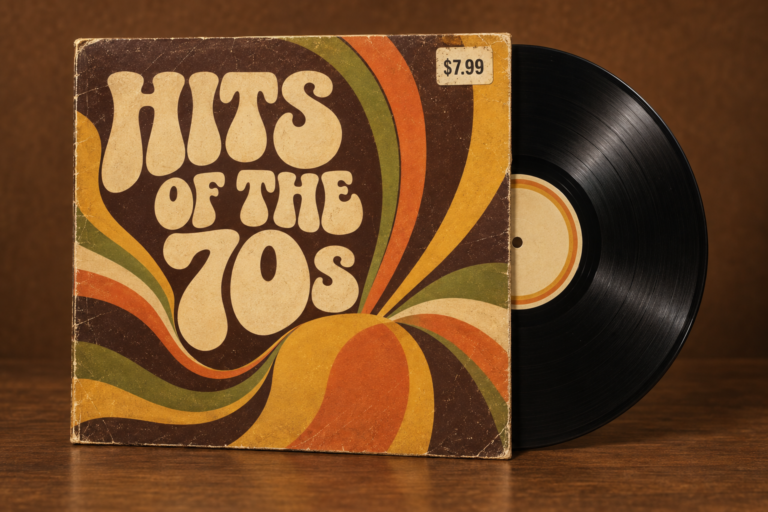
I Dreamed About Vinyl
and Woke Up Thinking About Why We Bought Music
By: Misti Flowers
This morning, I woke up realizing I had been dreaming about vinyl.
It was not one of those fuzzy dreams that disappears before you make it to the coffee pot. This one was detailed. It was like a memory of my own history with recorded music: what it took to hear a specific song when I was a child why I spent my money on albums.
The more I thought about it, the more I realized that the reason we bought music then is not necessarily the reason people buy physical music now.
We like to imagine that people have always bought records mainly because they wanted to support the artists they loved. Sometimes that was absolutely true. I bought music from artists that I admired. I wanted the pictures, the liner notes and the whole experience. I wanted to hold the album, study it and feel connected to the person who made it.
But that was not the whole story.
Sometimes we bought music because buying it was the only reliable way to hear a favorite song whenever we wanted.
Waiting Beside the Radio
When I was a teenager in the 1980s, music was everywhere, but it was not available on command.
If I heard a song on the radio and wanted to hear it again, I had choices, but every choice had limits. I could wait for the station to play it again. I could call and request it, then hope I was near the radio when it aired. I could keep a blank cassette loaded and try to press Record at exactly the right moment.
That method came with its own challenges. You might miss the first few seconds or the DJ might talk over the intro. Occasionally, someone in the room might make noise at precisely the wrong time. Still, many of us built cassette collections that way, one carefully recorded song at a time.
Or I could go buy the album.
I did both.
Singles existed, of course, but they were not especially attractive to me. A single gave me the song I already knew. An album gave me that song along with possibility.
The radio hit might have been what persuaded me to spend the money, but the rest of the album had songs I had never heard. Not every track was released as a single back then. There was no streaming service where I could preview the entire record before deciding whether it was worth spending money on. I had to take it home, put it on the turntable and discover what else was there.
Maybe the album contained another song I would love even more than the hit. Maybe it contained three. Maybe the rest of it was a let down and I had just paid full price for one good song and a very attractive cardboard sleeve.
That was the gamble, and the mystery itself was part of the allure.
Before My Time, the Same Need Was Already There
That desire to control what we heard did not begin with teenagers and cassette recorders.
In the 1940s, people could hear music on the radio, at dances, in clubs or on jukeboxes. But those experiences were controlled by a broadcaster, a venue or a coin slot. If someone wanted to hear a particular recording at home, at a time of their choosing, they generally needed to own it.
Records then were commonly shellac 78s that held only a few minutes per side. In 1948, Columbia introduced the long-playing 33⅓ rpm record. RCA introduced the seven-inch 45 the following year. The Library of Congress recording timeline shows just how rapidly listening technology was changing.
During the 1950s and early 1960s, the 45 rpm single became a major way to buy popular music. It was affordable and direct: the song people wanted was usually on one side, with another song on the back.
That history matters because listeners were not always forced to buy a complete album for one favorite track. For many years, the single was the product.
But as LPs became more important, albums grew into something larger than containers. Artists began treating them as complete works, with sequencing, themes, artwork and songs that belonged together. By the late 1960s and throughout the 1970s, the album had become both an artistic statement and the industry’s favorite commercial package.
I grew up during that album culture. I remember its appeal, but I also remember its restraints.
Loving the Album and Being Stuck With It
An album could become a world of its own.
You sat with the artwork. You read every word on the jacket. You learned who wrote each song, who played which instrument and where it was recorded. You did not merely hear a song and move on. You lived with the record long enough for unfamiliar tracks to become familiar.
That kind of listening could create a deeper relationship with the music. Songs that did not grab you immediately sometimes became the ones that lasted.
But let’s tell the truth: sometimes an album was also the toll you paid to get the hit.
If the song was not available as a single, or if the single was no longer in the store, you bought the album. The music business could sell ten songs because the listener wanted one. Some albums rewarded the gamble beautifully. Others did not.
That does not mean people lacked affection for the artist. It means affection, curiosity, access and necessity were tangled together in the same purchase.
When a record sold, the industry could count the money. It could not know why the consumer bought the record.
Then We Began Taking Control
Cassettes gave listeners a little more power. We could record from the radio, copy a friend’s record or cassette and build mixtapes containing only the songs we wanted.
The mixtape was really an early playlist, except it required patience, timing and occasionally handwriting small enough to fit twelve song titles onto a tiny paper insert. We were pulling songs out of their original albums and arranging them around our own lives long before a streaming service learned to do it for us.
The industry noticed. In 1981, the British Phonographic Industry launched its famous “Home Taping Is Killing Music” campaign. Record companies feared that if people could copy music, they would stop buying as much of it.
That fear tells us something. The industry already understood that a sale did not always represent pure devotion to an artist. Sometimes a sale happened because the official recording was the only convenient copy available. When another route appeared, consumers often took it.
Napster made that behavior unmistakable in 1999. It did not invent the desire to hear individual songs. It simply removed nearly all the effort.
No waiting beside the radio. No buying an album for one track. No borrowing a cassette and copying it in real time. A person could search for the exact song and download it.
Napster was unauthorized, and its impact on artists and the recording business was enormous. But it also exposed something the industry could no longer deny: people wanted selection, immediacy and control.
Apple’s iTunes Music Store offered a legal version of that control in 2003 by allowing listeners to buy individual tracks. Then streaming went further. Instead of owning one download, listeners could access millions of recordings for a monthly fee or hear them with advertising.
By 2024, streaming accounted for 84 percent of U.S. recorded-music revenue, according to the RIAA.
At that point, buying a physical copy was no longer necessary to control what we heard.
And that is why a physical purchase
Today’s Buyer Already Has the Music
A young listener buying a vinyl record or CD today can probably stream it before making the purchase. They can listen to every song, skip what they dislike and decide whether the album deserves a place in their life.
The physical copy is no longer the admission ticket to the music. It is something extra.
It might be an art object, a collectible, a keepsake or a way of making musical taste visible. It might offer the ritual of dropping a needle, reading the credits and listening without a screen. It might represent permanent ownership in a world where songs, films and books increasingly live inside subscriptions.
And yes, it can be a deliberate statement of support for an artist.
I see that choice firsthand with Right Where I Belong, which is available on vinyl and CD for listeners who want a physical copy of the music.
Current research supports that interpretation. IFPI’s 2023 study found that people bought vinyl for reasons including collecting, physical ownership, the ritual of playing a record and simply having the object to look at. MusicWatch found that one in three active vinyl buyers specifically named supporting artists as a reason for buying, while 71 percent said ownership validated their appreciation of artists. A YouGov analysis found that 70 percent of Americans who enjoy buying physical music were happy to spend money supporting favorite artists, compared with 52 percent of Americans overall.
The younger generation is playing a significant part in this resurgence. Luminate found that 41 percent of consumers purchasing vinyl at independent record stores in its 2024 survey were under 35. Among vinyl buyers ages 13 to 17, 46 percent attended Record Store Day and bought a record that year. Luminate’s 2026 midyear report also reported a 16 percent increase in U.S. CD sales during the first half of 2026.
Streaming still dominates music consumption, so vinyl and CDs are not taking us back to the old industry. Something more interesting is happening.
Young listeners are using old formats to say:
- “I know I can stream this. I want to own it.”
- “This artist means enough to me that I want something tangible.”
- “I want my money to represent more than another fraction of a stream.”
We cannot interview every record buyer from the 1970s and 1980s and compare their motives statistically with buyers today. But we can recognize the enormous difference in circumstance. We bought physical music in an era when ownership was often the only practical route to repeatable, on-demand listening. Today’s young buyers already possess that convenience through streaming. When they purchase a physical edition anyway, the choice carries an intention the industry once assumed but could not always prove because listeners had fewer options.
What My Dream Was Really About
I think that is why my dream didn't disapate.
It was not only about vinyl. It was about the changing meaning of ownership.
I remember buying albums because I wanted the artist, the artwork and the experience. I also remember buying them because I wanted control over one song. I remember waiting beside the radio with a cassette ready. I remember the limitations, the discoveries and the pleasure of finding an unexpected song buried on side two.
Those experiences can all be true at once.
People in my generation bought music out of love, curiosity, necessity and convenience. Sometimes we were supporting an artist. Sometimes we only wanted one song. Often, we were doing both without stopping to separate the reasons.
Today, the necessity is largely gone. The song is already waiting on a phone.
So when a teenager chooses to buy a record or CD, saves for it, displays it, learns the credits and claims it as part of who they are, they are doing more than reviving something vintage.
They are choosing a relationship with music that streaming alone cannot give them.
And perhaps they are finally turning the physical sale into what the industry always wanted to believe it was: not merely payment for access, but a visible act of connection between a listener and an artist.

Want More Than The Article?
Explore the music, stories and releases behind Misti Flowers.
Contact: mistiflowersmusic@gmail.com
© 2026 Misti Flowers Music